
Virtual RUF Reports
Virtual RUF reports provide administrators with message-level visibility for emails that fail DMARC authentication.
Many email providers do not send DMARC failure (RUF/forensic) reports. As a result, administrators often cannot identify which specific message failed DMARC authentication or determine the reason for the failure.
When Avanan detects an email that fails DMARC while it is being processed in the Avanan network, it generates a virtual RUF report based on the available message details. These virtual reports enable administrators to troubleshoot and investigate issues more quickly while supporting shared insights across the Avanan network.
If Avanan RUF - Opt-out is enabled in DMARC Configuration, the customer chooses not to participate in this capability. In this case, Avanan continues to evaluate DMARC for incoming messages but does not generate, share, or receive virtual RUF reports.
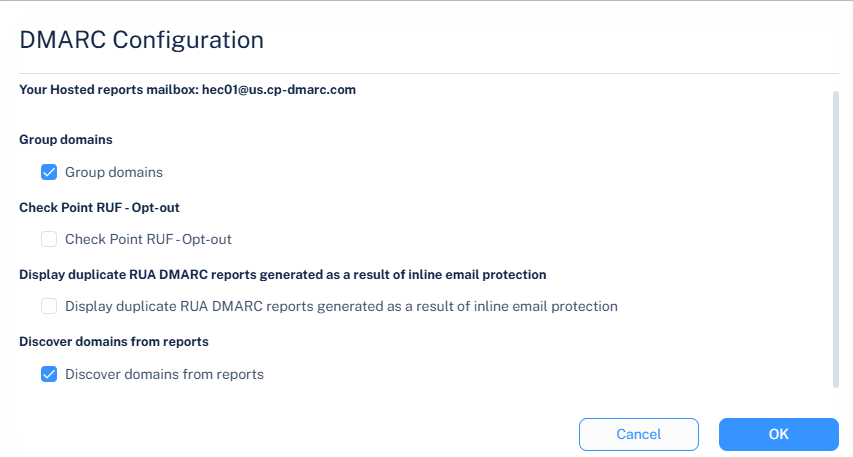
Opting out reduces forensic visibility for DMARC failures and limits the ability to benefit from collective insights gathered across the Avanan network.
External Reporting Authorization Record
To make sure that the DMARC records for your domain are accepted by Avanan, after you add the Avanan hosted mailbox to your DMARC record, Avanan automatically adds an External Reporting Authorization Record.
It creates a domain name in the format: <your_domain>.com._report._dmarc.dmarc-cp.com. In this domain, a TXT record is added with this content: "v=DMARC1":
|
Text |
Description |
|---|---|
|
TXT |
<your_domain>.com._report._dmarc.dmarc-cp.com |
This process could take a couple of hours after Avanan detects the update to your DMARC record.