Prerequisites - BlackBerry UEM Cloud

00:03: This tutorial guides you through the prerequisites in the BlackBerry platform for

00:07: integrating BlackBerry UEMClosed Unified Endpoint Management. An architecture and approach that controls different types of devices such as computers, smartphones and IoT devices from a centralized command point. Cloud with Mobile Security.

00:11: Log in to your BlackBerry UEM account.

00:15: Under Organization, click Services and go to the UEM tab. In the BlackBerry Cloud

00:20: section,

00:20: click Open for your BlackBerry account.

00:23: The BlackBerry Cloud authentication page appears.

00:25: Enter your credentials and click Sign In.

00:29: Go to Settings, External integration. For iOS devices, go to the Apple Push

00:34: Notification tab and make sure you have a valid Apple Push Notification certificate

00:39: installed.

00:40: For Android devices, go to the Android and Chrome Management tab and make sure your

00:45: Android Enterprise connection is active.

00:48: Go to Services, UEM tab and expand your BlackBerry Cloud account.

00:52: Note down the tenant ID. You need it while creating a new Client.

00:56: Next, you need to create an OAuth2 Client in your BlackBerry UEM account for the

01:01: interaction with Mobile Security API. To do that, go to the Applications tab.

01:07: Click Add Application.

01:09: Enter a name for the application. In the Entitlement

01:12: ID field, enter a unique reverse DNSClosed Domain Name System. A hierarchical distributed naming system for computers, services, or resources connected to the internet or a private network. Used to translate names into IP addresses. name.

01:15: For example, comdotcheckpointdotportal.

01:17: From the Type list, select Solutions. In Capabilities, select BlackBerry

01:22: Platform APIs. Then, click Add Application.

01:26: In the application you created,

01:27: go to the BlackBerry Platform APIs tab to manage API access for your application.

01:34: Click Add Template.

01:36: In the Redirect URLs field, enter the URL as shown.

01:40: Select Type as Web.

01:42: Select Grant Type as client credentials

01:45: Select Response Types as None.

01:48: Select Token Endpoint Auth Method as client secret basic

01:52: Select Application Scope as Organization.

01:55: In API Scopes, select Mobile Device Management. Then, click Register.

02:00: Next, go to the Client tab and click "Add Client" to create a new client for your

02:04: application.

02:06: Enter a name for the client. In the Tenants field, select the tenant ID of your

02:10: BlackBerry Cloud

02:11: instance (noted in step 6) After entering the details, click Register.

02:17: The system creates a Client ID and Client Secret. Copy and save these values for

02:22: future use.

02:23: Next, go to Services,UEM page and open the BlackBerry Cloud instance.

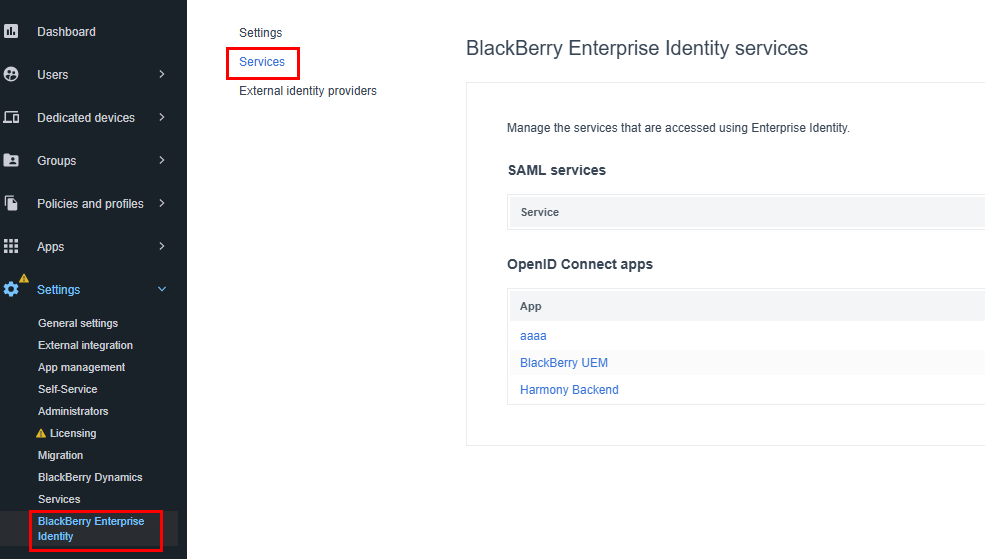
02:28: Go to Settings, BlackBerry Enterprise Identity and then click Services.

02:33: Under OpenID Connect apps, click +.

02:36: Select the API client you created.

02:40: Click "Save" to apply and save theconfiguration changes.

02:44: This completes the prerequisites setup for Blackberry UEM integration. Next, configure the integration in the Mobile Security Administrator portal. Click the link at the top-right corner to watch part-2.


Creating an OAuth2 Client for Mobile Security

For the interaction with Mobile Security at the API, you must create a dedicated OAuth2 Client in your BlackBerry UEM.

Important - Creating an OAuth2 Client is mandatory for BlackBerry UEM Cloud integration. It is optional for the On-Premises integration.

  1. Log in to your BlackBerry UEM account.

  2. Go to Services > UEM and expand your BlackBerry Cloud account. Note down the tenant ID.

  3. Go to Applications.

  4. Click Add Application.

  5. Enter the application details:

    1. Enter a name for the application.

    2. In the Entitlement ID field, enter a unique reverse DNS name. For example, com.checkpoint.portal.

    3. From the Type list, select Solutions.

    4. In Capabilities, select BlackBerry Platform APIs.

    5. Click Add Application.

      The system creates a new application.

  6. Go to the Application tab and select the application you created.

  7. Click the BlackBerry Platform APIs tab.

  8. Select the Template tab and click Add Template.

  9. Enter the template details:

    1. In the Redirect URLs field, enter https://localhost:9443/cb

    2. Select Type as Web.

    3. Select Grant Type as client_credentials

    4. Select Response Types as None.

    5. Select Token Endpoint Auth Method as client_secret_basic

    6. Select Application Scope as Organization.

    7. In API Scopes, select Mobile Device Management.

  10. Click Register.

  11. Go to the Client tab.

  12. Click Add Client.

  13. In the Client Name field, enter a name for the client.

  14. In the Redirect URLs field, enter the Redirect URL entered in the template.

  15. In the Tenants field, select the tenant ID of your BlackBerry Cloud instance (see step 2).

  16. Click Register.

    The system creates a Client ID and Client Secret.

  17. Copy and save the Client ID and Client Secret values for future use.

Configuring BlackBerry Enterprise Identity Settings

  1. Go to Settings > BlackBerry Enterprise Identity.

  2. Click Services.

  3. Under OpenID Connect apps, click +.

  4. Select the API client you created.

  5. Click Save.