
Health and Safety Information
Read these warnings before setting up or using the appliance.

|
Warnings:
|
Handle SGM system parts carefully to prevent damage.
These measures are sufficient to protect your equipment from static electricity discharge:
-
When handling components (CMMs, SGMs, PSUs, SSMs) use a grounded wrist-strap designed for static discharge elimination.
-
Touch a grounded metal object before removing the board from the anti-static bag.
-
Hold the board by its edges only. Do not touch its components, peripheral chips, memory modules or gold contacts.
-
When holding memory modules, do not touch their pins or gold edge fingers.
-
Restore SGMs to the anti-static bag when they are not in use or not installed in the Chassis.
Some circuitry on the SGM can continue operating after the power is switched off.
-
Do not let the lithium battery cell (used to power the real-time clock on the CMM) short.
The battery can heat up and become a burn hazard.
Warnings:
-
DANGER OF EXPLOSION IF BATTERY IS INCORRECTLY REPLACED. REPLACE ONLY WITH SAME OR EQUIVALENT TYPE RECOMMENDED BY CHECK POINT SUPPORT.
-
DISCARD USED BATTERIES ACCORDING TO INSTRUCTIONS FROM CHECK POINT.
-
-
Do not operate the processor without a thermal solution. Damage to the processor can occur in seconds.
-
Before you install or remove a chassis, or work near power supplies, turn off the power and unplug the power cord.
For California
Perchlorate Material - special handling can apply. See: http://www.dtsc.ca.gov/hazardouswaste/perchlorate
The foregoing notice is provided in accordance with California Code of Regulations Title 22, Division 4.5, Chapter 33. Best Management Practices for Perchlorate Materials.
This product, part, or both may include a lithium manganese dioxide battery, which contains a perchlorate substance.
Proposition 65 Chemical
Chemicals identified by the State of California, pursuant to the requirements of the California Safe Drinking Water and Toxic Enforcement Act of 1986, California Health & Safety Code s. 25249.5, et seq. ("Proposition 65"), that is "known to the State to cause cancer or reproductive toxicity" (see http://www.calepa.ca.gov)
WARNING
Handling the cord on this product will expose you to lead, a chemical known to the State of California to cause cancer, and birth defects or other reproductive harm. Wash hands after handling.
Declaration of Conformity
The manufacturer:
|
Manufacturer's Name: |
Check Point Software Technologies Ltd. |
|
Manufacturer's Address: |
5 Ha'Solelim Street, Tel Aviv 67897, Israel |
declares under our sole responsibility, that the products:
|
Model Number: |
CPXXXX64000XXXXXXXXXXXXXXXX CPXXXX44000XXXXXXXXXXXXXXXX (where X may be any alphanumeric character, blank and "-") Class A product |
|
Product Options: |
64000 44000 |
|
Date First Applied: |
April 2017 |
conform to these Product Specifications:
|
Certification |
Type |
|---|---|
|
|
|
Information Technology Equipment - Radio Disturbance Characteristics Unintentional Radiators |
|
EMC/EMI |
|
Information Technology Equipment - Safety |
Federal Communications Commission (FCC) Statement
Note:
This equipment has been tested and found to comply with the limits for a Class A digital device, pursuant to Part 15 of the FCC Rules. These limits are designed to provide reasonable protection against harmful interference when the equipment is operated in a commercial environment. This equipment generates, uses, and can radiate radio frequency energy and, if not installed and used in accordance with the instruction manual, may cause harmful interference to radio communications. Operation of this equipment in a residential area is likely to cause harmful interference in which case the user will be required to correct the interference at his own expense.
Information to user:
The user's manual or instruction manual for an intentional or unintentional radiator shall caution the user that changes or modifications not expressly approved by the party responsible for compliance could void the user's authority to operate the equipment. In cases where the manual is provided only in a form other than paper, such as on a computer disk or over the Internet, the information required by this section may be included in the manual in that alternative form, provided the user can reasonably be expected to have the capability to access information in that form.
Canadian Department Compliance Statement
This Class A digital apparatus complies with Canadian ICES-003. Cet appareil numérique de la classe A est conforme à la norme NMB-003 du Canada.
Japan Class A Compliance Statement

European Union (EU) Electromagnetic Compatibility Directive
This product is herewith confirmed to comply with the requirements set out in the Council Directive on the Approximation of the Laws of the Member States relating to Electromagnetic Compatibility Directive 2014/30/EU.
This product is in conformity with Low Voltage Directive 2014/35/EU, and complies with the requirements in the Council Directive 2014/35/EU relating to electrical equipment designed for use within certain voltage limits and the Amendment Directive 93/68/EEC.
Product Disposal
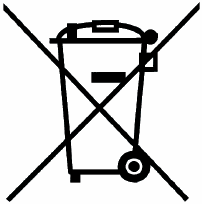
This symbol on the product or on its packaging indicates that this product must not be disposed of with your other household waste. Instead, it is your responsibility to dispose of your waste equipment by handing it over to a designated collection point for the recycling of waste electrical and electronic equipment. The separate collection and recycling of your waste equipment at the time of disposal will help to conserve natural resources and ensure that it is recycled in a manner that protects human health and the environment. For more information about where you can drop off your waste equipment for recycling, please contact your local city office or your household waste disposal service.
Danger:
-
Many components described in this document can be damaged by Electrostatic Discharge (ESD). Follow the precautions described here and before specific procedures detailed in the document to protect static-sensitive components from ESD-related damage.
-
Static electricity can harm system components. Perform service at an ESD workstation and follow proper ESD procedure to reduce the risk of damage to components. We strongly recommend you to follow proper ESD procedure, which can include wrist straps, when servicing equipment.
Take these steps to prevent damage from Electrostatic Discharge (ESD):
-
When unpacking a static-sensitive component from its shipping carton, do not remove the component's antistatic packing material until you are ready to install the component in the system. Just before unwrapping the antistatic packaging, be sure you are at an ESD workstation or grounded. This will discharge any static electricity that may have built up in your body.
-
When transporting a sensitive component, first place it in an antistatic container or packaging.
-
Handle all sensitive components at an ESD workstation. If possible, use antistatic floor pads and workbench pads.
-
Handle components and boards with care. Do not touch the components or contacts on a board. Hold a board by its edges or by its metal mounting bracket.
-
Do not handle or store system boards near strong electrostatic, electromagnetic, magnetic, or radioactive fields.